 |
|
| crabs text index | photo index |
| Phylum Arthropoda > Subphylum Crustacea > Class Malacostraca > Order Decapoda > Brachyurans > Family Sesarmidae |
| Nipah palm
crab Labuanium politum Family Sesarmidae updated Mar 2026 written and photos by Rui Quan Oh Where seen? This small brown crab is only found on Nipah palms and usually only active at night. The first sign of its presence is the distinctive serrated edge damage on the palm leaves where it has fed. In 2015, the crabs were sighted at Pulau Ubin for the first time. It was later found at Pasir Ris and other Northern mangroves on the mainland. Features: Body width 3.5cm. Body flat, rectangular, legs flat with pointed tips for scrambling over slippery surfaces. Pincers strong. Body in adult deep brown or reddish purple, pincers bright red, legs greyish purple. Young crab lighter brown, shorter broader legs. Nothing like home: This crab lives only in Nipah palms (obligate inhabitant). During the day, the crab hides deep in the narrow spaces between the stalks of the leaves, making it difficult to spot. It was regarded among the rarest crabs in Southeast Asia until more was learned of its lifestyle. When disturbed, the Nipah palm crab may leap away from the leaf and take cover immediately on the ground. After some time, it makes an effort to return home. However, this happens slowly, as its specialised legs, while good at climbing, are not as efficient at walking on flat ground. What does it eat? The crab's home is also its source of food. Once night falls, it starts to feed. It quickly climbs the tall leaf stalks to the slender leaflets of the palm with legs adapted to this specific function. It has been seen balancing precariously on the narrow leaflets, as high as 9 metres off the ground! It uses its strong pincers to tear off small pieces of the leaflets, leaving a distinctive serrated edge on the leaflets. The tips of the pincers form a spoon-like structure, making the pinching action very effective. The crab will often choose an animal protein source, such as crickets, over the leaves when available. |
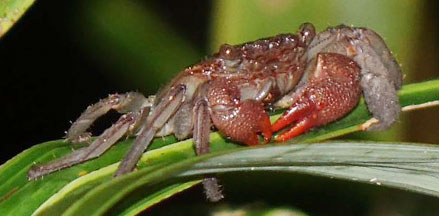 Pasir Ris Park, Dec 25 Photo shared by Rui Quan Oh on facebook. |
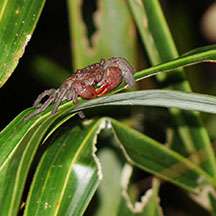 With distinctive serrated edge leaf damage. Pasir Ris Park, Dec 25 Photo shared by Rui Quan Oh on facebook. |
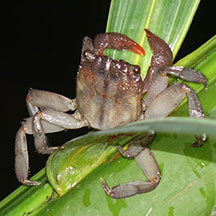 Pasir Ris Park, Dec 25 Photo shared by Rui Quan Oh on facebook. |
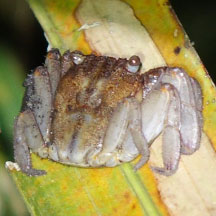 Pasir Ris Park, Dec 25 Photo shared by Rui Quan Oh on facebook. |
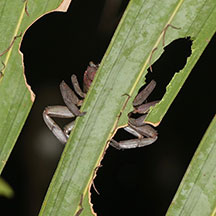 With distinctive serrated edge leaf damage Pasir Ris Park, Dec 25 Photo shared by Rui Quan Oh on facebook. |
| Similar crabs: While other crabs such as the Face-banded sesarmine crab have been seen in Nipah palms, these are only seen at the base of the palm with the very broad stem, not on higher up on leaf stalks and leaflets. Perhaps the Nipah palm crab is unmatched in its ability to scale the tall palm! |
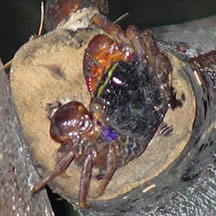 Face-banded sesarmine crab Pasir Ris Park, Dec 25 Photo shared by Rui Quan Oh on facebook. |
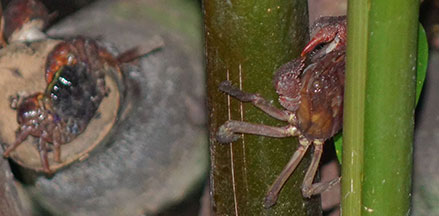 Nipah palm crab can climb higher. Pasir Ris Park, Dec 25 Photo shared by Rui Quan Oh on facebook. |
| Status and threats: Being completely reliant on the palm, habitat loss is a serious threat to their survival. As at 2024, the NIpah palm is listed as 'Vulnerable' in Singapore. |
| Other sightings on Singapore shores |
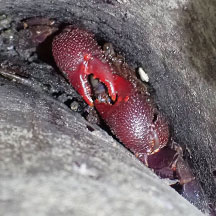 Sungei Pang Sua, Jan 26 Photo shared by Rui Quan Oh on facebook. |
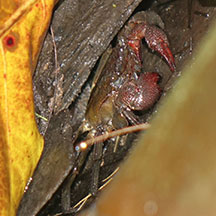 Admiralty Park, Dec 25 Photo shared by Rui Quan Oh on facebook. |
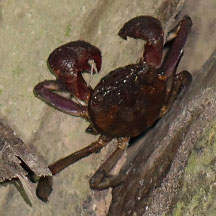 Admiralty Park, Dec 25 Photo shared by Rui Quan Oh on facebook. |
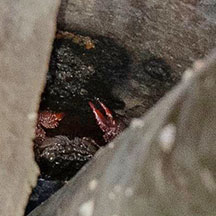 Sungei Buloh, Mar 26 Photo shared by Rui Quan Oh on facebook. |
| Acknowledgements With grateful thanks to Rui Quan Oh for the write up and photos for this fact sheet. References
|